What is an emotional weather map?
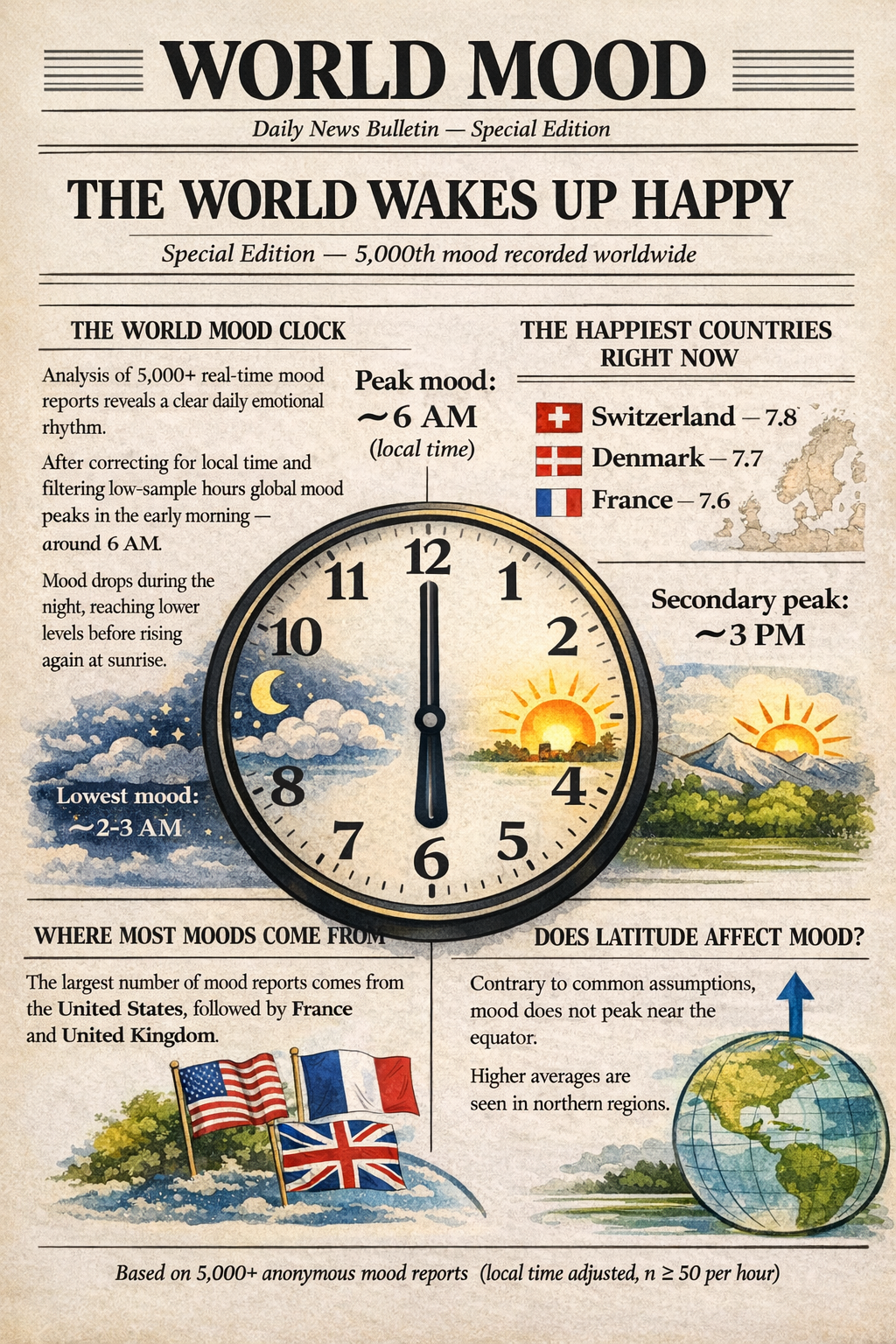
We already use weather as a shared language: sunny, cloudy, calm, stormy. Mood2Know applies a similar idea to emotions by turning small anonymous mood inputs into a living global picture.
Instead of long surveys or detailed profiles, Mood2Know asks one simple question: How is your mood right now, from 1 to 10? That single input becomes part of a broader emotional landscape that anyone can explore.
You can also visit the world mood map to explore the live global view, or browse visual mood stories generated from the data.
How Mood2Know works
- Choose your mood on a simple 1 to 10 scale.
- Use automatic location, with manual location available only if geolocation does not work.
- Contribute anonymously without creating an account.
- Explore the map instantly, even before submitting a mood.
- See live indicators such as the world mood score, mood history, and the happiest country.
Mood2Know is designed to stay fast and low-friction: no profile, no feed, no social pressure.
What you can explore
Mood2Know is more than a map with scattered markers. It reveals a broader collective signal through several live indicators and visual patterns.
- World mood map with clustered emotional signals across regions.
- Global mood score showing the current average mood.
- Happiest country based on the latest visible patterns.
- Mood history to see how the emotional landscape changes over time.
- Visual stories created from Mood2Know data and insights.
If you're looking for other tools and alternatives, you can also explore our guide to the best mood trackers worldwide.
Anonymous and privacy-aware by design
Mood2Know is not a mood diary and not a diagnostic tool. It does not try to explain why someone feels a certain way. Its purpose is to make collective emotional patterns visible, not to build personal profiles.
The system stores a simple anonymous signal: mood, approximate location, and an anonymous identifier. No names, no emails, and no personal profile are required.
Why this experiment matters
Most emotions remain invisible at collective scale. Yet at any moment, millions of people experience joy, fatigue, calm, stress, relief, or uncertainty. Mood2Know makes a small part of that invisible layer visible.
Over time, these signals shift across countries and time zones. What emerges is not an individual story, but a shared human pattern: simple, imperfect, and alive.
Designed to be easy to explore
Recent improvements were made from user feedback: the map is visible even before adding a mood, manual location is available when automatic geolocation fails, and location is intentionally less precise to better respect privacy.
FAQ
Is Mood2Know a diagnostic or mental health tool?
No. Mood2Know does not diagnose, analyze or interpret individual emotions. It simply visualizes anonymous mood signals at a collective level.
Do I need an account?
No. Participation is intentionally frictionless and does not require account creation.
Can I explore the map before sharing my mood?
Yes. The map is visible even before you contribute, so you can explore the experience first.
Why do you ask for location?
Location helps place each mood on the world map. Automatic geolocation is used by default, and manual location only appears as a fallback. Location is intentionally approximate to better protect privacy.
What data is stored?
A mood value, an approximate location, and an anonymous identifier. No name, no email, and no personal profile are required.
Can I update my mood?
Yes. Submitting again updates your latest mood for your anonymous identifier.
What else can I explore besides the map?
You can also explore live indicators such as the global mood score, mood history, the happiest country, and visual stories generated from the data.
Open the emotional weather map
Explore the live map, share your mood in seconds, and discover the world’s emotional landscape as it evolves.